‘Yahoo-Yahoo Subsidy!’ Atiku Accuses Tinubu Of Copying His Fuel Relief Plan, Mocks 30-Day Petrol Discount: ‘What Happens On Day 31?’
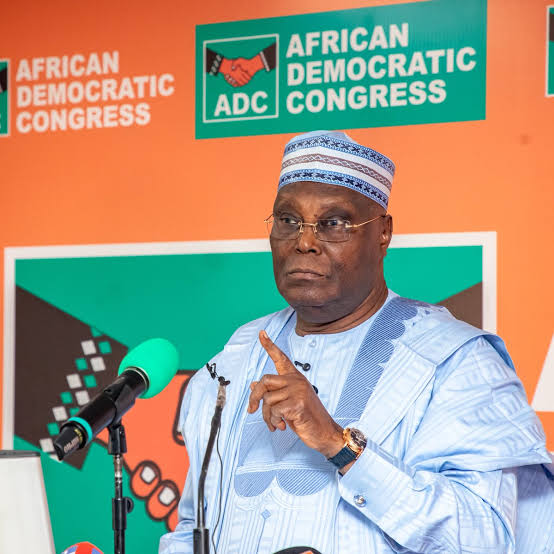
ABUJA — Former Vice President Atiku Abubakar has accused President Bola Tinubu’s administration of adopting his proposed petroleum production subsidy plan after initially dismissing it, describing the Federal Government’s 30-day petrol discount initiative as a temporary measure incapable of providing lasting relief to Nigerians.
Atiku, the African Democratic Congress (ADC) presidential candidate for the 2027 election, made the allegations on Friday, October 9, 2026, during the inauguration of the party’s Presidential Campaign Council at the Shehu Musa Yar’Adua Centre in Abuja.
In a strongly worded address, the former vice president criticised Tinubu’s handling of the economy, accusing his administration of worsening the cost of living through rising fuel prices, expensive transportation, unreliable electricity and growing pressure on businesses and households.
He argued that Nigerians had endured more than three years of economic hardship under the current administration and should not be expected to applaud a temporary petrol discount announced ahead of another general election.
“Bola, your government has made life unbearable and called it reform,” Atiku said, accusing the president of demanding painful sacrifices from ordinary citizens while failing to provide sustainable economic relief.
Atiku Questions Tinubu's 30-Day Petrol Discount
The ADC presidential candidate’s criticism centred on the Federal Government’s announcement of a 30-day petrol discount at NNPC stations, with priority reportedly given to public transport operators.
Atiku argued that the initiative was insufficient to address the broader economic consequences of rising petrol prices, particularly their impact on food prices, transportation, manufacturing, agriculture and small businesses.
He also questioned what would happen after the 30-day period expires, insisting that Nigerian households and businesses require predictable, long-term policies rather than temporary interventions.
“More importantly, you owe Nigerians an answer: what happens on day 31?” he asked.
According to Atiku, a short-term discount cannot provide the stability required by transport operators setting fares, farmers moving produce, traders restocking their shops and manufacturers relying on fuel to power their operations.
He maintained that fuel costs affect virtually every sector of the economy, meaning that a limited discount at petrol stations would not automatically translate into meaningful reductions in the prices of goods and services.
Claims Tinubu Adopted His Production Subsidy Proposal
Atiku alleged that Tinubu’s administration had previously rejected his proposal for targeted support to reduce fuel costs but had now embraced a similar principle through the newly announced discount initiative.
He recalled that when he proposed measures to ease the burden of petrol prices, the government questioned his understanding of economic policy.
The former vice president said the administration’s latest intervention amounted to an admission that its previous approach had failed to adequately address the hardship facing Nigerians.
“Your government said it could not be done. Now, in a desperate and clumsy retreat, you have shamelessly embraced the principle you mocked. You owe me an apology,” Atiku said.
He, however, insisted that the government had failed to implement the central elements of his proposal, describing its 30-day discount as a temporary palliative rather than a comprehensive economic strategy.
Atiku compared the administration’s approach to a student copying an examination answer without understanding the underlying principles, arguing that the government had adopted the idea but omitted the safeguards necessary to make it sustainable.
He also accused Tinubu’s economic team of failing to develop a lasting solution to the country's cost-of-living crisis.
The allegations were part of Atiku's political address, and his claim that the government copied his proposal was not independently established in the speech.
Outlines Alternative Fuel Support Framework
The former vice president outlined what he described as a more sustainable alternative to the government's petrol discount initiative.
Under his proposed framework, government support would apply specifically to petroleum products refined in Nigeria and sold to Nigerian consumers.
He said the intervention should have clearly defined limits, receive explicit budgetary approval and undergo independent auditing to prevent abuse and ensure transparency.
Atiku also proposed excluding imported petroleum products from the arrangement, arguing that targeted support for locally refined products could encourage domestic production while helping reduce fuel costs for consumers.
“My alternative is clear. Support petroleum products actually refined in Nigeria and sold to Nigerians. Cap the support. Put it in the budget. Audit it independently. Exclude imports,” he said.
He added that the government should publicly disclose the cost of the programme and the savings delivered to consumers.
According to him, such an approach would provide families with more predictable relief while creating incentives for domestic producers to increase output.
Atiku further argued that a lasting economic recovery must extend beyond petrol prices to include affordable food, reliable electricity, job creation, business expansion and improved security on roads and farms.
He maintained that economic growth would remain meaningless to millions of Nigerians if households continued to struggle to afford basic necessities.
Accuses Tinubu Of Failing To Take Responsibility
Atiku also rejected what he described as the administration’s tendency to blame previous governments for the country’s economic difficulties.
He argued that Tinubu, as the sitting president, must accept responsibility for the consequences of the policies implemented under his leadership.
According to him, the rising cost of petrol, declining purchasing power, increasing operating expenses for businesses and the pressure on household budgets require urgent government attention.
“The petrol price is your problem. The collapsing purchasing power is your problem. The shops closing under the weight of fuel and power costs are your problem. Take responsibility for the country you govern,” he said.
He further questioned whether the petrol discount would produce measurable reductions in transportation fares and the prices of essential goods.
Atiku asked how the government intended to ensure that public transport operators passed the benefits of the discount to passengers and whether farmers, traders, manufacturers and households would receive meaningful relief.
He described the initiative as an inadequate response to the economic challenges Nigerians had experienced since Tinubu assumed office.
Inaugurates ADC Presidential Campaign Council
Beyond his criticism of the Federal Government, Atiku used the occasion to formally inaugurate the ADC Presidential Campaign Council ahead of the 2027 general election.
He welcomed members of the council and urged them to approach their responsibilities with urgency, dedication and a clear understanding of the economic challenges facing the country.
Atiku charged the campaign team to take the party’s message to markets, motor parks, farms, university campuses and communities across Nigeria.
He also urged members to explain the party’s proposed policies to voters, including how the measures would be financed and implemented.
According to him, the campaign council must prioritise practical engagement with Nigerians rather than focus solely on political titles and positions.
He described the forthcoming presidential election as an opportunity for Nigerians to determine the direction of the country's economic and political future.
Atiku urged eligible voters to participate in the electoral process, arguing that the ballot remained an important instrument for demanding accountability and changing government.
He also warned against another four years of what he characterised as hunger, economic hardship and national decline under the current administration.
Demands Electoral Transparency And Independent Audits
Atiku also raised concerns about the credibility of the 2027 elections, calling for reforms to strengthen transparency in result collation and public confidence in the electoral process.
He argued that even the best economic policies would have limited value if voters could not trust that their ballots would be accurately counted and reflected in the final results.
The ADC presidential candidate called for immediate public access to polling-unit results and the protection of the rights of political parties, civil society organisations and accredited observers to independently verify electoral outcomes.
He also advocated the live broadcast of state and national collation proceedings, as well as independent audits of election technology before and after elections.
Atiku further proposed establishing an independent commission to investigate and prosecute electoral offences, alongside stronger penalties for vote suppression, result manipulation and electoral fraud.
He maintained that such measures would strengthen democratic accountability rather than undermine the authority of the Independent National Electoral Commission (INEC).
According to him, election technology should promote transparency and public confidence rather than prevent independent scrutiny.
The former vice president stressed that accredited party agents and observers should be allowed to verify results without replacing the constitutional responsibilities of INEC.
Warns Against Restrictions On Opposition Campaigns
Atiku also criticised attempts to restrict opposition politicians from campaigning in parts of the country, insisting that every political party must be allowed to seek votes across Nigeria.
He specifically referred to an alleged attempt to prevent an opposition candidate from campaigning in Benue State, warning that such incidents should not be repeated.
He called on federal and state authorities to respect the constitutional rights of opposition parties and their candidates to move freely, express their political views and engage voters.
“There will be no ‘no-go’ areas in Nigeria,” Atiku declared.
He said the ADC would campaign across the country, from the Niger Delta creeks to communities in the northern savannah, and resist efforts to prevent its candidates from reaching voters.
Atiku added that the party would defend its political rights through lawful means, including the courts and the electoral process.
Says Nigerians Will Judge Tinubu On His Record
Concluding his address, Atiku insisted that a 30-day petrol discount could not erase the economic difficulties Nigerians had experienced over the preceding three and a half years.
He argued that voters would assess the Tinubu administration based on its overall record rather than a temporary intervention announced ahead of the 2027 election.
The ADC presidential candidate maintained that the country needed leadership capable of developing and implementing sustainable economic policies that would make food, transportation, electricity and other essentials more affordable.
He also urged members of the Presidential Campaign Council to make the welfare of Nigerian families the central message of their campaign.
Atiku's address marked an escalation of his political criticism of Tinubu's economic policies as preparations for the 2027 presidential election gather momentum.
While the former vice president presented his proposed production subsidy as a sustainable alternative to the government's temporary discount, the effectiveness, fiscal implications and practical implementation of such a programme would depend on its detailed design and execution.
The Federal Government's petrol discount initiative and Atiku's proposed framework therefore remain central to the emerging political debate over how Nigeria should respond to high fuel costs and the wider cost-of-living crisis


0 Comment(s)